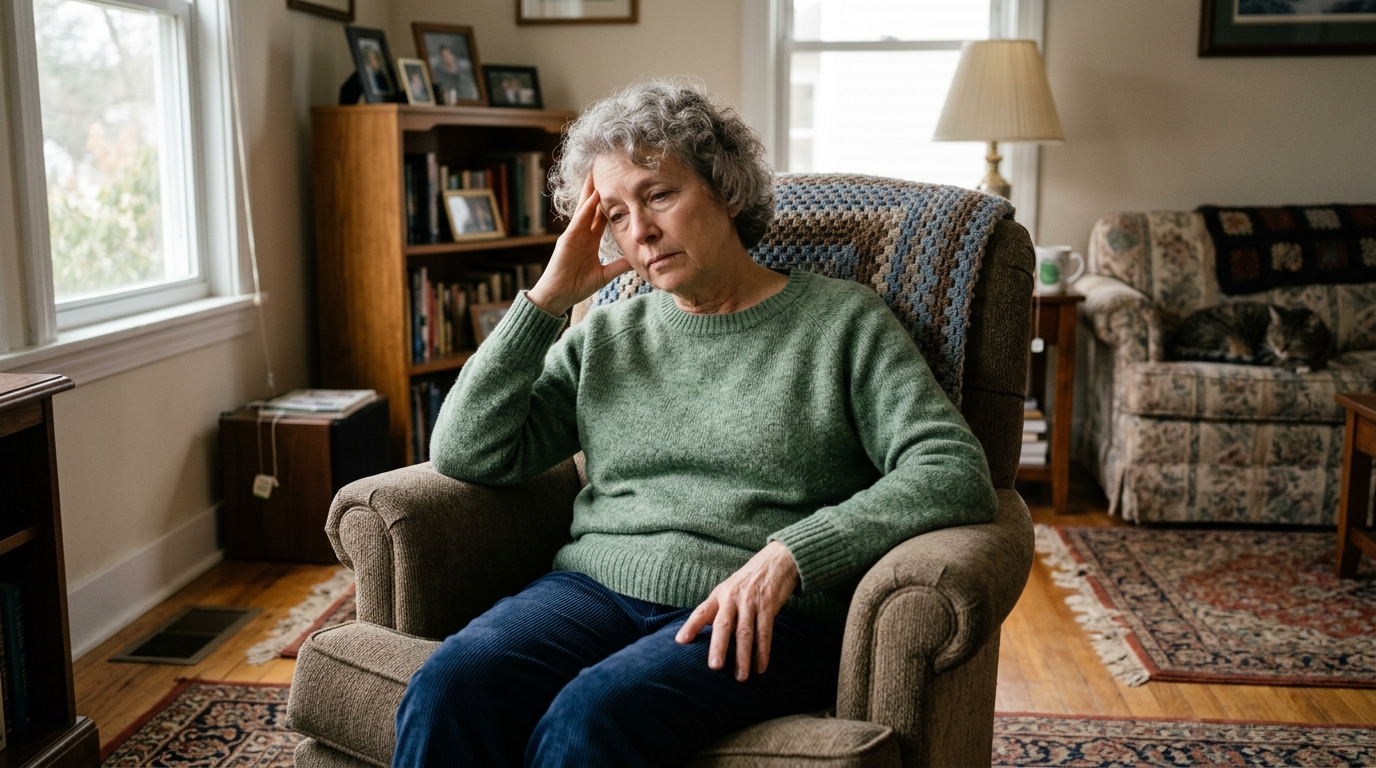
Barbara W., 63, from Knoxville, Tennessee, can recite her Meniere's management protocol from memory. Less than 1,500 milligrams of sodium per day. Betahistine twice daily. A diuretic. No alcohol. No caffeine. No skipping sleep. She has followed this protocol for seven years with the discipline of someone who knows exactly what happens when she does not. The unpredictable vertigo attacks, lasting 30 minutes to several hours. The fullness and pressure in the left ear. The ringing that rises before an attack and sometimes stays afterward.
She manages. She does not get better.
"My ENT told me in year two that Meniere's is about management, not cure," she said. "He was matter-of-fact about it. I accepted it. I didn't know I had another option."
Seven years of meticulous management. Still having episodes three to four times per year, each one still capable of leaving her confined to bed for a full day. Still carrying the low-level anxiety of not knowing when the next attack would arrive.
What her ENT had never ordered was a cervical MRI with attention to the vertebral arteries.
Check Availability: Neckline 4-in-1 Massager$119.99 (Spring Sale, 50% Off) | 30-Day Money-Back | Free US Shipping
What Meniere's Disease Actually Requires
True Meniere's disease is defined by endolymphatic hydrops: excess fluid pressure inside the membranous labyrinth of the inner ear. This fluid imbalance creates the characteristic symptom triad: episodic vertigo lasting 20 minutes to several hours, fluctuating low-frequency hearing loss, and tinnitus or aural fullness.
The management approach, low sodium, diuretics, betahistine, is designed to reduce endolymphatic pressure. For patients with true endolymphatic hydrops, this approach has supporting evidence behind it.
The clinical challenge: the same symptom triad can be produced by a completely different mechanism. One that does not involve fluid pressure at all.
The Vertebral Artery Hypothesis
The vertebral arteries are the primary blood supply to the inner ear. They run upward through the transverse foramina of the cervical vertebrae and converge at the brainstem before supplying the basilar artery, which feeds the cochlea and the vestibular apparatus. At the level of C1 and C2, the vertebral arteries are at their most anatomically vulnerable: they curve significantly as they enter the skull base, and the surrounding cervical musculature is in direct proximity.
When the upper cervical spine is under chronic stress, from a lost cervical curve, chronic muscle spasm, or degenerative changes at C1-C2, the vertebral artery on the affected side can experience intermittent, positionally dependent compression. Reduced cochlear blood flow does not require any fluid imbalance. It reduces the metabolic support available to the hair cells and the stria vascularis. The result: episodic vertigo, pressure and ringing in the ear, and hearing fluctuation.
"This is not the same as Meniere's disease. It does not involve endolymphatic hydrops. Diuretics, a low-sodium diet, and betahistine do nothing for a vascular compression problem at C1-C2."
Meniere's is a real condition. It affects a significant number of people. But the diagnostic criteria still involve clinical judgment. Some patients who receive the label may have a cervicovascular component, either instead of or alongside true Meniere's, that has never been identified or addressed.
Why Management Plateaus
The low-sodium, betahistine, diuretic protocol addresses endolymphatic pressure. When it works, it works by reducing the fluid volume and pressure inside the membranous labyrinth. For patients with true Meniere's disease, this reduces episode frequency and severity.
For patients with a cervicovascular component, this protocol has no mechanism of effect. The vertebral artery compression is not affected by sodium restriction or diuretics. The ringing and pressure generated by reduced cochlear perfusion are not endolymphatic. The standard management addresses the wrong physiology.
This is not a failure of the ENT. It is a structural gap in the diagnostic pathway: ENTs evaluate the ear, not the cervical vasculature. Identifying a cervicovascular component requires a different kind of assessment.
The gap: ENT specialists evaluate the ear with precision. The cervical vasculature is outside their training. When Meniere's management plateaus despite compliance, the question "has the cervical spine been evaluated?" is rarely asked.
The Cervical Evaluation
Barbara's ENT had followed her meticulously for seven years. Her audiograms showed the classic low-frequency hearing loss pattern. Her symptoms matched the Meniere's criteria. The diagnosis was not unreasonable. What had never been evaluated was the cervical spine. No cervical X-ray. No Doppler evaluation of the vertebral arteries. No assessment of whether Barbara's vertigo attacks had any relationship to neck position or cervical muscle tension.
Barbara had significant neck tension. She had always attributed it to stress. She had a minor rear-end collision seventeen years ago that had produced a few weeks of whiplash symptoms she had never pursued. "The PT asked me about the car accident and I almost forgot to mention it," Barbara said. "Seventeen years ago. Minor fender-bender. I didn't think it was relevant."
A physical therapist experienced in cervicogenic vestibular disorders conducted a full cervical assessment. The lateral X-ray showed significant cervical lordosis loss. Manual palpation revealed marked tension at C1-C2 and the surrounding suboccipital muscles. Range of motion testing showed limited rotation to the left, the same side as Barbara's affected ear. The PT asked whether her episodes were ever triggered by turning her head to the left. Thinking back: yes. Often. The correlation had simply never been tracked.
The PT explained the vertebral artery mechanism and made clear she was not diagnosing Barbara or saying her Meniere's diagnosis was incorrect. What she was saying: there appeared to be a cervical component that had never been addressed, and addressing it was worth trying. Barbara began cervical traction twice a week, with heat therapy and manual work on the suboccipital muscles. She continued her Meniere's management protocol without changes.
Featured Solution
Neckline 4-in-1 Massager
Clinical cervical traction for daily home use
- 26-degree traction incline decompresses C1-C2 joints
- Deep heat reduces chronic suboccipital muscle spasm
- EMS interrupts the cervical tension cycle
- Massage targets upper cervical musculature directly
- 15 minutes per day. Used alongside existing treatment.
- 30-Day Money-Back Guarantee
- Free US Shipping
Was $239.98 | 50% Off Today
Barbara's Month-by-Month Results
Week 1: No immediate change in episode pattern, as expected. Neck tension noticeably reduced after each session.
Week 3: Background ringing slightly less constant. No new vertigo episodes yet.
Month 2: First month without a vertigo episode in seven years. Barbara noted the correlation cautiously.
Month 3: Second consecutive episode-free month. The ear pressure remained but was less intense day-to-day.
Month 5: One mild episode, significantly less severe than typical attacks. "My ENT looked at my follow-up audiogram and said the low-frequency loss had slightly improved. He was surprised. I told him what I had been doing."
What Other Users Are Saying
"I lived with the Meniere's label for nine years. Did everything right. Low sodium, betahistine, diuretics. Had maybe four to six attacks a year and accepted it. A friend in physical therapy suggested I look into cervicogenic vestibular research. I found a PT who checked my cervical spine and found significant compression at C1-C2 with limited left rotation. Cervical traction and the Neckline for home maintenance have given me my first truly episode-free stretch in almost a decade. I am not saying Meniere's is fake. I am saying mine may have had a second problem nobody was treating."
"Eight years on the Meniere's protocol. The management kept things somewhat stable but never fully resolved anything. A physical therapist who specializes in cervicogenic work evaluated my neck for the first time. Lost curve, chronic spasm at C1-C2, limited rotation toward my symptomatic side. She explained the vertebral artery connection and I was skeptical. Four months of cervical traction later, my episodes are a fraction of what they were. The Neckline is part of my daily routine. I am still careful with sodium and still take betahistine. But the cervical component was clearly doing something my ENT never looked for."
"I got the Meniere's diagnosis at 59. Now I am 67. The protocol helps but the episodes never fully stopped. A physical therapist at a new practice I started seeing last year evaluated my cervical spine and suggested the vertebral artery compression explanation. She was very careful and said this was a possibility, not a certainty. After six months of cervical traction work and using the Neckline at home, I have had two episodes total. Before this I was averaging six to eight per year. I do not know the full explanation. I know the results."
Frequently Asked Questions
Are you saying Meniere's disease isn't real?
No. Meniere's disease is a real, documented condition involving endolymphatic hydrops. This article addresses a specific clinical pattern: patients who carry the Meniere's diagnosis but may also have a cervicovascular component that standard Meniere's management does not address. These are not mutually exclusive.
How would I know if I have a cervical component alongside Meniere's?
Indicators worth investigating: your vertigo episodes are triggered or worsened by specific neck positions; you have significant neck tension on the same side as your affected ear; you have a history of whiplash or prolonged forward head posture; your management protocol has plateaued despite compliance. A physical therapist specializing in cervicogenic vestibular dysfunction can assess these factors.
Should I stop my Meniere's medication to try this?
No. Do not alter any prescribed medication protocol without your physician's guidance. Cervical traction addresses a structural component. It does not replace medical management of Meniere's disease. Barbara continued her full Meniere's protocol throughout.
What does the vertebral artery mechanism explain that Meniere's management doesn't?
The low-sodium, diuretic, betahistine protocol addresses endolymphatic pressure. Cervicovascular compression reduces cochlear blood flow through a completely different mechanism. Management that reduces endolymphatic pressure will not affect a vascular compression issue.
Is cervical traction safe for someone with Meniere's disease?
Gentle cervical traction is widely used in clinical settings. Consult your physician before starting any new protocol, particularly if you have cervical disc pathology, cervical instability, or have been advised against cervical manipulation. The Neckline provides gentle traction at 26 degrees, not aggressive manipulation.
What makes the Neckline different from a standard neck pillow or support?
The 26-degree traction incline is the key differentiator. This is not a massage device that happens to support the neck. It replicates the mechanical action of clinical cervical traction: gentle axial decompression of the upper cervical joints at the anatomically precise angle used in physical therapy protocols, combined with heat, EMS, and massage.
Check If the Neckline 4-in-1 Is Still Available
Spring Sale pricing while stock lasts.
- 26-degree cervical traction incline
- Deep heat + EMS + massage
- $119.99 (50% off Spring Sale)
- 30-Day Money-Back Guarantee
- Free US Shipping
Individual results may vary. Not intended as medical advice. Consult your physician.